Among the train journeys you should take at least once in your life is definitely a ride on the Bernina Red Train, which connects Italy and Switzerland. The route from Tirano to St. Moritz is 61 km long and reaches an elevation of 2,200 m at its highest point: a true masterpiece of engineering. In this article, we’ll share our experience on the Bernina train, with plenty of useful tips to help you plan your trip.
Bernina Train: route, prices and useful tips
Riding the Bernina Train had been one of our dreams for years. Not an unreachable dream, exactly, but one of those we kept putting off. We finally managed to make it happen for Marco’s thirtieth birthday, traveling on the Bernina Railway in winter.
Although it’s possible to do the Bernina Red Train in a single day, we decided to split the experience over 2 days to have the chance to see more stops along the route. To do this, we purchased the UNESCO World Heritage Pass, which we’ll tell you more about later in the article. We stayed for 2 nights in Tirano at Contrada Beltramelli, in a charming restored hamlet in Valtellina.

When it comes to the Bernina Red Train, you can never have too many tips. The information available online is often confusing and disorganized, but don’t worry: we’re here to help you plan your trip and enjoy every minute of this experience.
Table of Contents
- Bernina Train: the route and which stops to make
- Tirano: departure station of the Red Train
- Brusio spiral viaduct
- Le Prese
- Poschiavo
- Cavaglia
- Alp Grüm
- Ospizio Bernina
- Bernina Diavolezza
- Morteratsch
- Pontresina
- St. Moritz: arrival station of the Red Train
- The difference between the Bernina Express and the regional Red Train
- Bernina Train: prices and packages
- Bernina Train: 2024 schedules
- Bernina Train in 2 days: tips for a weekend
- The best time to go on the Bernina Train

Bernina Train: the route and which stops to make
The Bernina Train departs from Tirano, in Lombardy, and climbs an elevation gain of over 1,800 m before ending its journey in the Swiss town of St. Moritz. The railway was built between 1906 and 1910 to transport goods and passengers, and since 2008 it has been listed as a UNESCO World Heritage site. The route stretches for 61 km and can be completed in two and a half hours, not counting intermediate stops.
Climbing by train through the Alps is already a magical experience in itself, offering unforgettable views from the windows, but traveling from Tirano to St. Moritz without making a single stop would be a missed opportunity. Not to mention that (in our opinion) this Swiss town alone isn’t worth the trip.
During a day on the Bernina Red Train, we recommend making between 2 and 3 stops, chosen based on your interests. Between one ride and the next, you’ll need to wait 40-70 minutes before catching the next train.
The stops we chose to make were Le Prese, Alp Grüm, and Ospizio Bernina. Which stops should you make on the Bernina Train? Hop aboard and find out with us!

Tirano: departure station of the Red Train
Arriving at the station square in Tirano, you’ll have the Alta Valtellina railway in front of you, while on the right you’ll find the Rhaetian Railway station, where you catch the Bernina Train.
If you’ve already purchased your tickets (for the regional train or the Bernina Express, as we’ll see later), all that’s left is to climb aboard and take your seat, ideally next to a window.
On the first stretch, the train crosses the center of town, passing near the Sanctuary of the Madonna di Tirano. This explains why, entering Tirano from the Stelvio state road, you’ll come across level crossings right in the town center. After crossing the Italy-Switzerland border, the first stop is the small hamlet of Campocologno, and from there the train begins climbing Val Poschiavo.
Brusio spiral viaduct
And here we are, after just 10 minutes of travel, facing the first marvel: the Brusio spiral viaduct. This stone bridge the train crosses is truly spectacular and perfect for a few shots from an open window. Don’t worry if you didn’t manage to capture the carriages on the spiral viaduct — you’ll have another chance on the way back!

Le Prese
After Brusio, the train continues climbing toward Lake Poschiavo, where the surrounding mountains are reflected in the water. After passing the Miralago stop, we decided to get off at Le Prese for a walk along the lakeshore.
Continuing along the trail that starts at Hotel Le Prese, a 5-minute walk brings you to one of the giant swings from the Swing the World project. Swinging with Lake Poschiavo at your feet is a lovely diversion before catching the train again.
In summer, you might choose to stop at Le Prese or Miralago to do the Lake Poschiavo loop: an easy walk suitable for everyone, 7.5 km long and completable in about 2 hours.

Poschiavo
Back aboard the Bernina Train, the next stop is Poschiavo, the main town of the valley of the same name in the Canton of Graubünden. The town has a well-preserved historic center with Renaissance and Baroque-style buildings.
If you decide to get off at this stop, be sure to visit the Spanish Quarter, built by emigrants who returned to Poschiavo in the 19th century after making their fortunes working abroad.
Leaving the charming village behind, the train begins climbing toward the highest part of its route. The gradients become steeper, and the landscape outside the window alternates between conifer forests, steep cliffs, valleys, and tunnels carved into the rock.
Cavaglia
By now at 1,700 m of elevation, you reach the Cavaglia stop, where you can visit the Giants’ Kettles. These are unique geological formations: large, round, smooth holes carved into the rock by the rotating movement of boulders, within an ancient glacial stream.
The site is open from May to October, with free admission, and can be explored in 90-120 minutes. For more information, visit the website of the Cavaglia Glacier Garden.

Alp Grüm
And here we are at the most scenic station on the Bernina Red Train, Alp Grüm: a terrace overlooking the Piz Palü glacier and the lake of the same name. They say the view from here is truly sublime, but since we arrived during a snowstorm, we can’t vouch for it.
Unable to enjoy the view, we took refuge in the station buffet over a steaming plate of pizzoccheri. The Alp Grüm is also a hotel where you can spend the night, starting from CHF 160 for a double room. Sleeping at 2,091 m in the mountains of the Engadin seems rather romantic to us.
A fun fact: on the station’s facade, there’s a wooden plaque with an inscription in Japanese. This is because the Red Train is twinned with the Japanese Hakone Tozan Railway, built according to the same principles as the Bernina with an 80% gradient.

Ospizio Bernina
We resume our ride to reach, after a few scenic bends, the highest point of the Red Train’s route, Ospizio Bernina, at 2,253 m. Here too, the station is home to a hotel and a restaurant for passing travelers.
The view from the window can take in Lago Bianco, Lago Nero, and Lago Piccolo (unless, like us, you stop here during a snowstorm).
⚠️ At the Ospizio Bernina restaurant, you can only pay in cash: euros are also accepted.
Bernina Diavolezza
Bernina Diavolezza is the stop for those who want to get closer to the mountain and the activities you can enjoy there, both in winter and summer.
Here you can take the cable car, which in about 10 minutes will take you to nearly 3,000 m of elevation: to ski or simply to admire the view of the Piz Palü, Piz Bernina, and Piz Morteratsch peaks. At the top is the Berghaus refuge, where you can also spend the night.

Morteratsch
From the Morteratsch stop (request stop), about a 50-minute walk will take you to the tongue of the glacier of the same name. Simply follow the Bernina Glacier Trail for 2 km to find yourself at the foot of this giant of ice.
The walk to the Morteratsch Glacier can be done year-round, even with strollers (except during our snowstorm, but let’s not dwell on that!).
Pontresina
The second-to-last stop on the Bernina Train, Pontresina is the gateway to Val Roseg, a destination much loved for outdoor activities. On one hand, there’s cross-country skiing, with groomed trails for the sport; on the other, there are horse-drawn carriage rides, one of the most charming ways to explore the surrounding area.
For more information on carriage excursions and to book one (starting from CHF 37 per person), you can visit the official website.

St. Moritz: arrival station of the Red Train
End of the line: St. Moritz. The train empties out and travelers scatter along the streets of this wealthy Swiss town. We find ourselves surrounded by things we’re not used to: gleaming sports cars, concierges outside luxury hotels, dazzling high-fashion storefronts, and people dressed in fur from head to toe.
It’s no exaggeration: St. Moritz is so bold in its display of wealth that visiting it becomes (almost) an entertaining experience. Or at least you need to have a bit of a sense of humor.
All this to say that, once we got off the train, we couldn’t wait to get back on board, to feast our eyes on the beauty of the landscapes along the way.

The difference between the Bernina Express and the regional Red Train
One of the main dilemmas for anyone planning a trip on the Bernina Railway is: which train should I take? Yes, because there are at least two options to choose from, Bernina Express vs. regional Red Train. Let’s look at the difference and the pros and cons of each.
PROS of the regional Red Train
- Lower cost: the regional Red Train costs only CHF 66.00 round trip in second class, while for the Bernina Express you need to add CHF 28.00 per leg for the assigned seat.
- No advance booking required: tickets for the regional Red Train can also be purchased at the station. There’s no need to plan particularly far in advance, since seats aren’t assigned. Whoever boards first gets the best seat and view.
- Possibility of making intermediate stops: those taking the regional Red Train can get off and back on as many times as they like during the same day, without needing to buy another ticket.
- Windows that open: the train’s windows can be lowered to take photos of the scenery without annoying glass reflections.
- Open-air carriages: in July and August, some fully open carriages are attached to the regional train, for a full immersion in the landscape. In this case too, seats cannot be reserved.

CONS of the regional Red Train
- Less comfort: the regional train is less comfortable and stylish than the Bernina Express in every respect, from the seats to the overall look. However, the carriages can vary, from the classic ones to the so-called Allegra carriages, introduced in 2010 and therefore more modern.
- Unassigned seats: to find a spot on the regional Red Train, plan to arrive at least 20-30 minutes before departure. Many carriages can be reserved by travel agencies, triggering real seat hunts during high-season periods.
PROS of the Bernina Express
- 360° panorama: the Bernina Express has large panoramic windows extending upward as well, allowing a 360° view of the surrounding landscape.
- Assigned seats: booking the Bernina Express guarantees you an assigned seat for the entire journey, so you won’t need to worry about arriving early before departure time.
- Speed: the Bernina Express takes only 2 hours and 15 minutes to reach St. Moritz from Tirano, compared to 2 hours and 30 minutes on the regional train.
- Comfort: the Bernina Express is modern and comfortable, with spacious, well-spaced seats.

CONS of the Bernina Express
- Windows don’t open: not a big deal if you just want to admire the scenery, but not being able to lower the windows will drive photography enthusiasts crazy, as their shots will be full of annoying reflections.
- Higher cost: adding CHF 28.00 per leg for the assigned seat on the Bernina Express is a significant extra cost compared to the regional train.
- No intermediate stops: anyone who gets off the Bernina Express at an intermediate stop won’t be able to board the next Bernina Express. They’ll lose their right to the assigned seat and will have to settle for completing their journey on the regional train.
- Advance booking required: if you want to travel on the Bernina Express, you’ll need to book at least 3 weeks in advance on the official website, because seats sell out quickly.
💡 Can’t decide? You could take the Bernina Express on the way there and the regional Red Train on the way back, or vice versa, to enjoy both travel experiences.

Bernina Train: prices and packages
Wondering how much it costs to ride the Bernina Train? Here’s a cost summary (updated as of April 2024).
The Red Train costs CHF 66 round trip in second class and CHF 114 round trip in first class for adults. Children up to 5 years old travel for free, while kids up to 15 years old pay CHF 33 in second class and CHF 57 in first class.
The surcharge for the Bernina Express is CHF 28 per leg. Starting six days before the trip, you can also purchase Last Minute deals.
💸 The current Euro-Swiss Franc exchange rate is as follows: 1 € equals 0.97 CHF (updated as of April 2024).
Tickets for the Bernina Train can be purchased online on the Rhaetian Railway website or directly at the departure station (recommended only during low-traffic periods and only for the regional train).

If you decide to split your trip over several days, you might find the UNESCO World Heritage Pass convenient, which allows unlimited train travel for 2 days between Thusis and Tirano (excluding the Bernina Express and Glacier Express), within 4 consecutive days. This pass costs CHF 75 in second class and CHF 120 in first class.
For a stress-free experience on the Bernina Red Train, you can also choose to rely on an organized tour from Milan. Online, you can find several with excellent reviews, such as:
- From Milan: St. Moritz and Bernina Express panoramic tour from €148
- From Milan: Bernina Train and day trip to St. Moritz from €135
- From Milan: Lake Como cruise, St. Moritz and Bernina Red Train from €175

Bernina Train: 2024 schedules
The Red Train’s schedule changes depending on the season. Click the links to find this year’s winter schedule and summer schedule.
In case of intermediate stops, at each one you’ll find a board letting you know when the next train passes. Watch out for the abbreviations: BEX indicates the Bernina Express, which you can only board if you have a reserved seat.
Bernina Train in 2 days: tips for a weekend
If, like us, you want to dedicate an entire weekend to discovering the landscapes of the Red Train, the most convenient option is to stay in Tirano. This town in Valtellina has lower prices than the Swiss towns and is very welcoming.
We stayed for 2 nights at Contrada Beltramelli, a charming rustic-style property in a small restored hamlet, offering double rooms, triple rooms, and apartments.

Breakfast with local, zero-mile products and homemade pastries is a real treat, and the staff are extremely kind. Unfortunately, we found the Contrada’s inn closed for vacation, but we read glowing reviews of its pizzoccheri!
We also suggest two places to eat in Tirano if you decide to stop in town:
- Caffè Novecento is highly recommended for an aperitivo thanks to its truly unique and sophisticated cocktails, which have also won several awards.
- Ristorante Parravicini, an elegant restaurant and wine bar offering traditional Valtellina dishes enhanced by a touch of modernity.

The best time to ride the Bernina Express
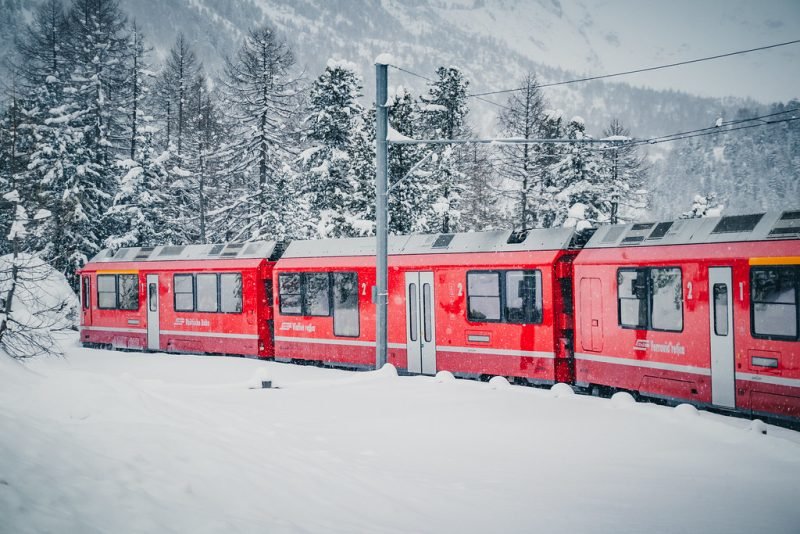
A journey on the Little Red Train can be very different depending on the time of year you choose to go. In winter, the Alpine landscape is covered in snow, and the train glides between white slopes and immense fir trees.
On certain days—as was our case—visibility can be very low, making it difficult to go on excursions. With the snow, however, the experience gains a sense of magic, making the train resemble the Polar Express or the Snowpiercer from TV.
Spring, summer, and autumn are the best times to fully enjoy a trip on the Bernina Railway. The long days and the varied colors of the landscape will allow you to make several stops along the way.

Choo choo! As the Little Red Train disappears around a bend, our guide comes to a close. Do you have any doubts, questions, or curiosities about this experience? Leave a comment below: we will get back to you before the next stop.
Enjoying our articles? Subscribe to our newsletter for travel updates, sneak peeks, and discount codes 🙂