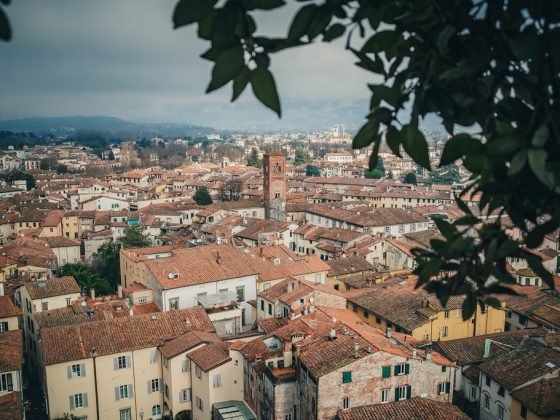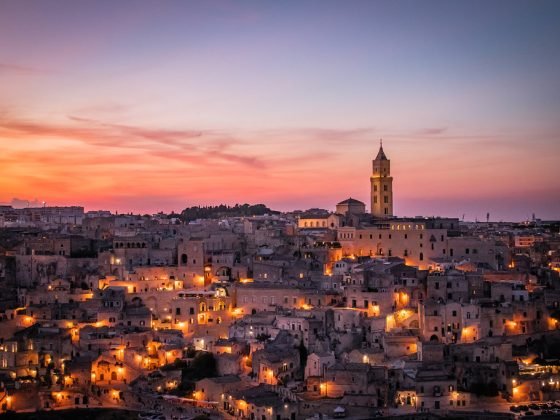
Do you dream of visiting the “Valley of the Trulli” and enjoying the Apulian dolce vita while strolling through the alleys of the white towns? In this guide, you will find everything you need to organize your itinerary in Valle d’Itria, from must-see attractions to tips on accommodation and restaurants.
Valle d’Itria on the road: our itinerary among trulli and white towns
“Why not Puglia?”, we said to ourselves while planning one of our autumn trips. Let the tourists pack away their beach towels and let’s go get to know Valle d’Itria, a destination that had been on our list for a long time.

So we booked a flight to Bari, rented a car and started our slow-paced tour among masserie, white towns, trulli, and karst caves. In Puglia, we visited Polignano a Mare, Monopoli, Locorotondo, Cisternino, Ostuni and the Castellana Caves, taking advantage of the short distance for a foray into Basilicata to discover Matera. We did not, however, stop in Alberobello, which we had visited on a previous occasion.
During our 4-day trip we stayed at Masseria Garrappa, a wonderful structure dating back to the 16th century, now transformed into a B&B. This masseria near Monopoli pampered us with its breakfasts and the scent of the citrus grove just steps from the pool: the ideal setting for a relaxing holiday.

If you are thinking of visiting Valle d’Itria and its surroundings, in this article you will find many tips and curiosities about these areas. Keep reading to discover the most beautiful towns to see and the absolute must-do experiences.
Table of Contents
- 1. Polignano a Mare
- 2. Monopoli
- 3. Locorotondo
- 4. Cisternino
- 5. Castellana Caves
- 6. Ostuni
- When to visit Valle d’Itria
- Where to stay in Valle d’Itria: Masseria Garrappa
- Where to eat in Valle d’Itria: restaurants and places to try
- How to get there and how to get around Valle d’Itria
- Outdoor experiences to do in Valle d’Itria

1. Polignano a Mare
“This place was created before Paradise,” wrote a street artist – Guido the flâneur – on a door in Polignano a Mare. Looking around, it’s hard to disagree.
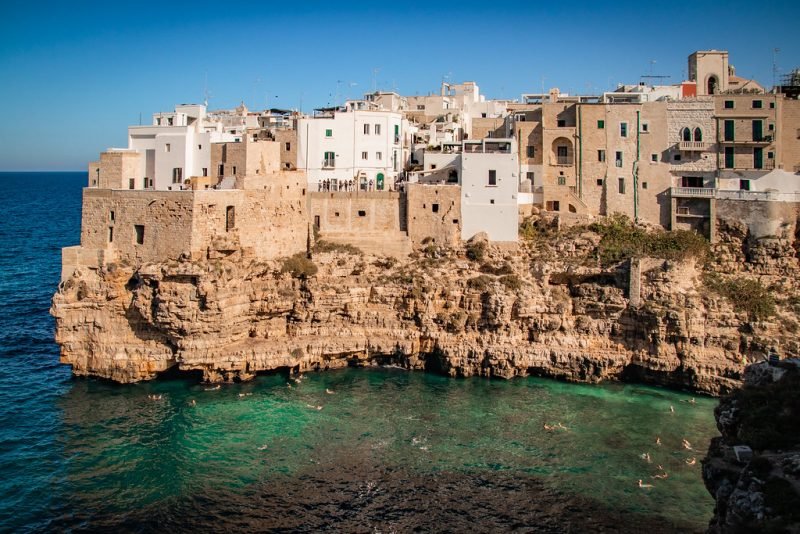
The blindingly white houses that almost seem to dive into the sea have remained in our memory like the most beautiful of postcards. We recommend getting lost in the alleys of the historic center, stopping every now and then to admire the sea from the terraces. Then continue beyond the center and be enchanted by the Polignano Caves, which stretch along the jagged cliffs.
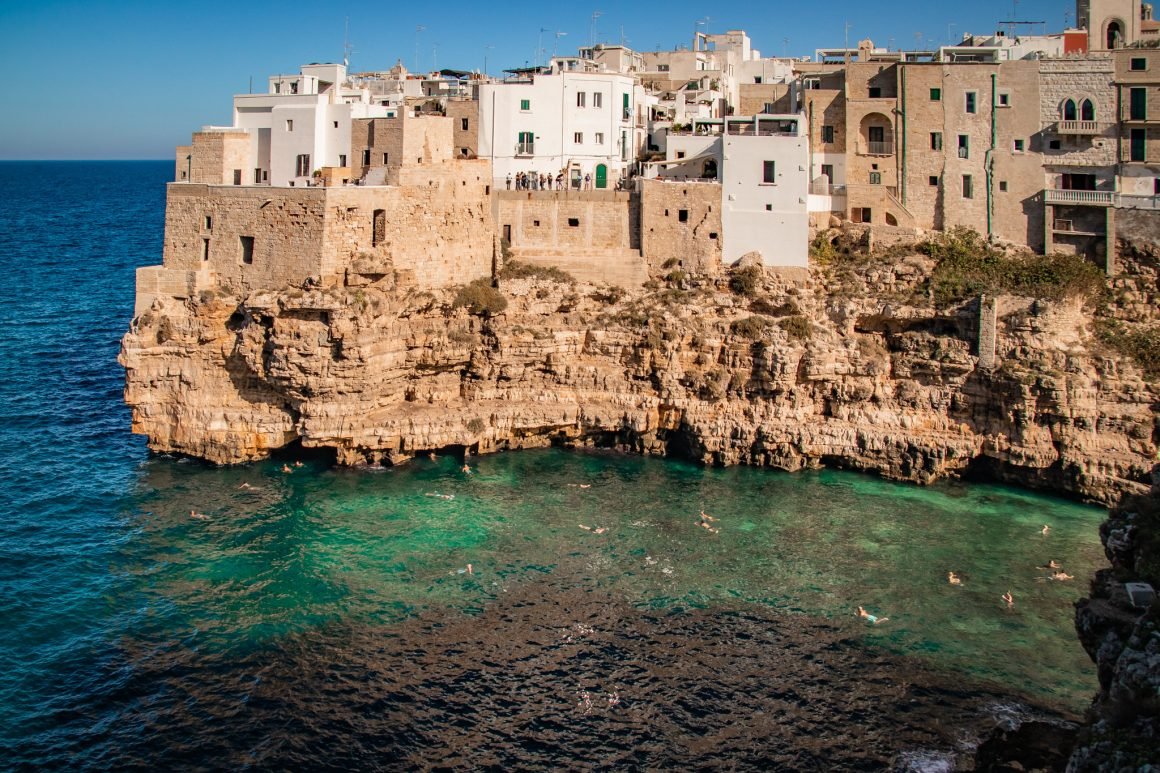
With a boat tour you can admire these beautiful natural formations from the sea, stopping in front of the Grotta della Rondinella, the Grotta dell’Arcivescovado, the Grotta delle Monache, and Grotta Palazzese, which houses an exclusive restaurant.
If talking about restaurants makes you hungry, stop for a lunch break at Pescaria, which opened its first “seafood fast food” right here in Polignano: their sandwiches with salmon tartare, fried octopus, and local products will not disappoint you.

For coffee, move a little further along to Super Mago del Gelo Mario Campanella, and order a “special coffee” with whipped cream, lemon zest, and almond amaretto. The vintage counter and faded photos hanging on the walls will transport you back in time.
Pass through the Arco Marchesale, the gateway to the historic center, leave it on your right and reach another of the symbols of Polignano a Mare: Lama Monachile, one of Italy’s most iconic beaches. A small, narrow inlet between golden cliffs, which in summer is swarmed by tourists and locals. Its blue-green waters are addictive: we could have stayed for hours taking photos from every angle.


Above the Lama, also known as Cala Porto, stands the Bourbon Bridge, which connects two parts of the city. Continuing further, you can enjoy one of the best views of Polignano a Mare from the Domenico Modugno Belvedere, where a statue of the singer-songwriter pays tribute to Polignano’s most illustrious citizen.
Diving enthusiasts train on the cliffs nearby, perhaps in view of the Red Bull Cliff Diving, an international championship that has stopped in the Apulian town for numerous editions. “A dive where the sea is bluer. Nothing more”.

2. Monopoli
Nestled on the Adriatic coast a few kilometers south of Polignano, Monopoli is another town that definitely deserves a visit if you happen to be in this area of Puglia.
Its relaxed atmosphere will make you fall in love with Monopoli at first sight. We recommend going there towards sunset, to walk under the walls of Charles V, from Cala Porta Vecchia beach to the Castle and the Old Port area.

Overlooking the small port is the historic Palazzo Martinelli which, together with the cobalt blue-hulled boats, creates a true window onto the sea.
During our visit, Monopoli was hosting two cultural events:
- Gozzovigliando, a folklore festival that catapulted us into a taranta of Apulian folk songs and dances (October);
- PhEST, an international photography festival featuring artists from all over the world, with various installations throughout the city (every year between September and November)

The historic center, like that of all the towns in Valle d’Itria, is an intricate labyrinth of white alleys, bars, and shops. After a few turns, you will inevitably end up in front of the Monopoli Cathedral, tucked between historic buildings in an adorable little square. The interior of the church is lavish and in Baroque style.

3. Locorotondo
With the visit to Locorotondo we finally enter the heart of Valle d’Itria, just 10 km from Alberobello. The funny name of this town derives from the Latin Locus Rotundus, literally “round place,” which already gives you a precise idea of its shape.
Locorotondo, in fact, is a circular village formed by several concentric rings. The milk-white alleys embrace each other in a continuous spiral until they reach the center of the town.
It is another of those places to discover slowly, taking the turns that most inspire you and lingering on the most beautiful views. That’s what we did too, armed with sunglasses to resist the blinding charm of upper Puglia.

We begin our tour of Locorotondo from Piazza Vittorio Emanuele, which welcomes us as soon as we pass the entrance to the village. At this point, we spend a good hour photographing alleys and adorable old people out for a stroll.
We remain enchanted in front of the cummerse, the typical dwellings with sloping roofs (again from the Latin cum vertice). Then we find ourselves in front of Palazzo Morelli, a historic building constructed in 1819 and a splendid example of civil architecture.

Of particular interest is also the Clock Tower, which in the past served as a university seat. Today, however, it houses the historical archive of Locorotondo. As for religious buildings, we recommend the Mother Church of San Giorgio, with its neoclassical facade, and the Church of Santa Maria della Greca from 1480, the oldest in all of Locorotondo.
To conclude the tour of the village, we recommend walking along via Nardelli, which, following the outermost ring of Locorotondo, offers a beautiful panoramic balcony over Valle d’Itria and, on the clearest days, a view that reaches as far as the sea.

4. Cisternino
The real falling in love happened in Cisternino, for us the most beautiful village in Valle d’Itria. We found this village less touristy and more authentic, thanks also to the omnipresent scent of grilled meat in the butcher shops and places hidden among the alleys.
Here, at Trattoria Bère Vecchie, we tasted the typical Apulian bombette and a plate of orecchiette “alla sempliciotta” (tomato, basil, and a grating of cacioricotta). We still dream of those bombette at night. So, with full bellies, we set off to explore the town.

Just like Locorotondo, Cisternino is also part of the circuit of the most beautiful villages in Italy. Its historic center is a succession of narrow streets, stairways, silent squares, and very white buildings.
Here too we find a Piazza Vittorio Emanuele, the beating heart of the town. Lively and full of places perfect for an aperitivo in the shade of the imposing Clock Tower, this square will become your point of reference every time you emerge from the tangle of alleys. The Mother Church of San Nicola, from the Romanesque period, set in the context of Piazza Garibaldi, is also worth a stop.


You will undoubtedly notice some colored “swings” hanging between the houses in the middle of the alleys. Cisternino is in fact also known as “the swinging village,” and each swing features aphorisms or more or less famous quotes. You might recognize phrases by Frida Kahlo, Dante, or Rino Gaetano. Other phrases are hidden outside shop entrances or in the quietest corners of the village.
The idea is quite recent: in 2021 the municipality of Cisternino developed this project as a metaphor for the closures and openings that characterized the pandemic period. The swings are a way to reflect on the value of moments of serenity and lightheartedness.


5. Castellana Caves
One of the most incredible places in all of Valle d’Itria is the Castellana Caves, a few kilometers from Monopoli. It is a huge complex of underground cavities of karst origin, among the most spectacular in Italy.
The caves extend for a good 3,348 meters in length, while reaching 122 meters below the surface at the point of maximum depth. These figures already give us an idea of the size of these cavities, and in fact, the complete guided tour lasts about 2 hours.
The visits start from the only cavity connected to the outside, called “the Grave”, a 60-meter deep chasm. The exploration of the caves began in 1938 by the speleologist Franco Anelli and his collaborators, such as the worker from Castellana, Vito Matarrese.
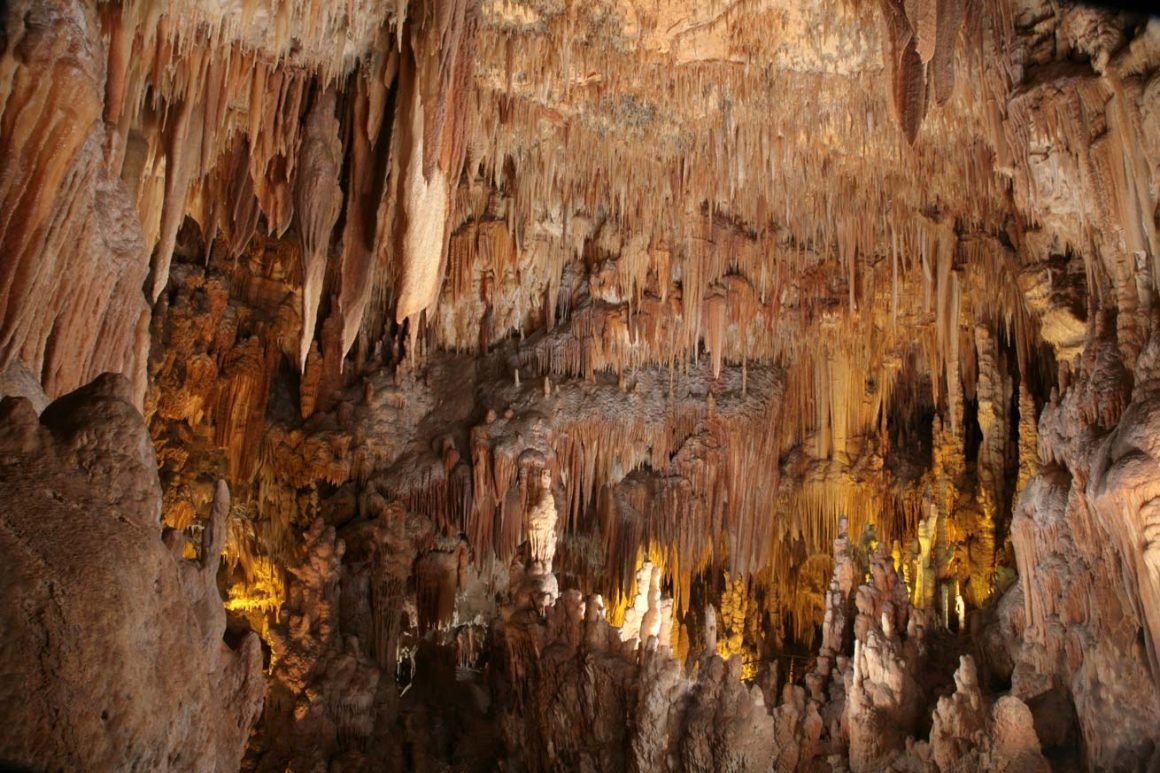
The most spectacular environment was discovered in 1939: it is the White Cave, so called for its pure white limestone formations. Along the path leading to the cave, we visit other incredible cavities and formations, such as the Great Cavern of Monuments, the Serpent Corridor, the Leaning Tower of Pisa Cavern, and the Dome Cavern.
Castellana Caves – Useful info
- We recommend visiting the caves following the complete itinerary: €18 adults, €15 children from 6 to 14 years old (100-minute visit, White Cave included)
- It is recommended to buy tickets online at least 1 day in advance to avoid queues and the risk of tickets being sold out (traveling out of season, we had no problems getting them on site)
- Visiting hours change depending on the season, itineraries, and languages. Discover the updated hours
- Inside the caves, once past the Grave, taking photos is not allowed
- Temperatures in the caves hover between 16° and 18° degrees. We recommend bringing a sweatshirt or a light jacket and wearing a pair of closed, non-slip shoes.
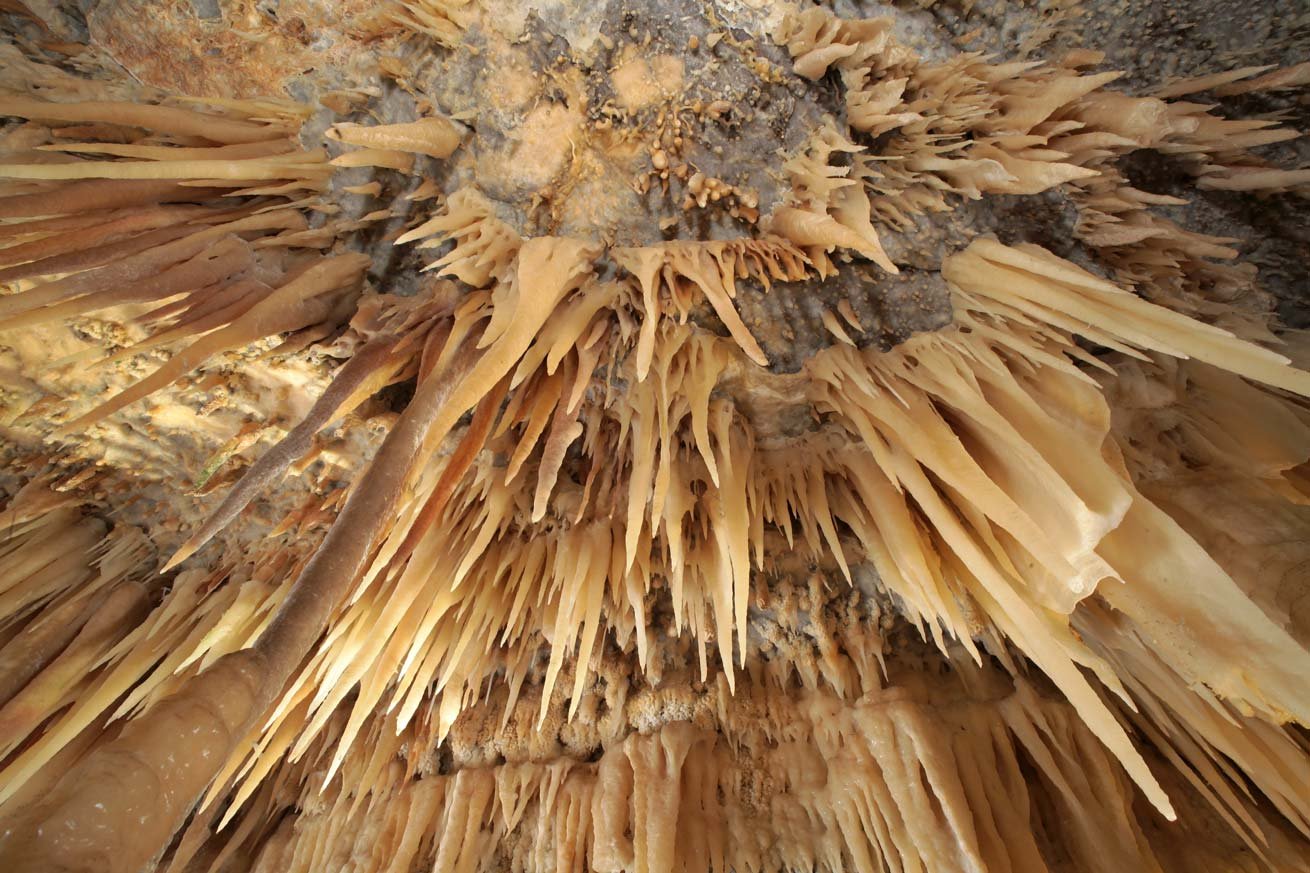
Credits www.grottedicastellana.it
6. Ostuni
The white city par excellence, Ostuni is the southernmost location we touched during our trip, venturing into the province of Brindisi. Observing the city from afar, what strikes us is the contrast between the houses painted with very white lime and the stone Co-cathedral.
We begin our visit from Piazzale della Libertà, where the austere Palazzo di San Francesco, now the Town Hall, overlooks the square. A little further on, the Column of Sant’Oronzo, an obelisk dedicated to the patron saint of Ostuni, towers high.
From the obelisk, we suggest you continue along Corso Vittorio Emanuele II for about 600 meters until you reach the belvedere of Piazzetta Martiri delle Foibe, from which you can admire a postcard panorama of Ostuni.


After taking a few photos, we head back the same way and get lost among the narrow streets that climb towards the highest part of the city. We walk along Via Cattedrale, passing by shops and inviting restaurant signs, until we reach the Cathedral of Santa Maria Assunta, also called the Ostuni Co-cathedral.
The contrast between the simple facade, embellished by a large rose window, and the interiors decorated in Baroque style is quite surprising. Opposite the Co-cathedral is the magnificent Arco Stoppa, which connects the Bishop’s Palace to the Seminary and is said to be an imitation of the Bridge of Sighs in Venice.


Passing under the arch, we immerse ourselves in the maze of narrow alleys of the white city, among colored doors, flower pots, and corners to photograph. Like the Blue Door, perhaps among the most Instagrammed places in all of Puglia, which with its sea-inspired colors emerges from the white of the wall.
Right next door, we recommend having an aperitivo at Borgo Antico Bistrot, with a beautiful panorama that stretches to the coast, to be admired between a cocktail and a giant platter of delicacies.

When to visit Valle d’Itria
Visiting Valle d’Itria in autumn turned out to be an excellent choice, both for the pleasant temperatures and for the lower concentration of tourists. Unless you are organizing a beach holiday, avoiding the summer months will allow you to enjoy this area of Puglia in a more authentic and relaxing way.
Obviously, spring is also an excellent time for this itinerary, while it might surprise you to know that Valle d’Itria is famous for its Christmas markets!

Where to stay in Valle d’Itria: Masseria Garrappa
The setting for our stay was Masseria Garrappa, a beautiful structure south of Monopoli, about 1 km from the coast.
In particular, we appreciated the design of the rooms, created from the granary and the noble floor of the ancient masseria, the genuineness of the breakfast products, and the magical citrus grove just steps from the pool. The masseria also houses an excellent restaurant offering traditional Apulian dishes and pizza.


Where to eat in Valle d’Itria: restaurants and places to try
If there is one thing that makes a holiday in Valle d’Itria even more pleasant, it is the experience of sitting at the table and tasting the delightful local cuisine. From octopus sandwiches to orecchiette and Apulian bombette, here are some addresses not to be missed.
Pescaria, Polignano a Mare
Succulent fish sandwiches in a location with a nautical design. Try the tartare sandwiches and those with roasted octopus, paired with other traditional products like stracciatella and turnip greens. We also loved the Salina beer produced with seawater.
- Piazza Aldo Moro 6/8, Polignano a Mare
- Website

Il Super Mago del Gelo Mario Campanella, Polignano a Mare
Despite its fame, this ice cream parlor has maintained the look of a “corner bar you wouldn’t give a penny of trust to.” But trust you must the Super Mago del Gelato and taste the special coffee with whipped cream, lemon zest, and homemade almond amaretto. We didn’t try the ice cream sundaes, but they say they are legendary.
- Piazza Garibaldi 22, Polignano a Mare

La Vite Turchese, Monopoli
A young wine bar among the alleys of Monopoli, not far from the Old Port. The ideal place to taste lesser-known Apulian wines paired with excellent cheese and cold cut platters. Fun fact: it has another location in Barolo.
- Via Cavaliere 20, Monopoli
- Website

Ristorante Dono, Monopoli
The restaurant at Masseria Garrappa specializes in traditional Apulian dishes, but also prepares pizzas in a wood-fired oven. If you dream of dining in a suggestive location, immersed among ancient olive groves, you are in the right place. Reservations recommended.
- Contrada Losciale 85, Monopoli
- Website

Trattoria Bère Vecchie, Cisternino
Tucked in an alley in Cisternino, this trattoria immediately attracted us with its festive and welcoming air, with checkered tablecloths straight out of an Italian postcard. The bombette are the best ever tasted: flavorful, tender, and in different flavors, from the most traditional to the spicy ones. If you can’t choose between bombette and orecchiette, do as we did and order both.
- Via Regina Elena 8, Cisternino


Borgo Antico Bistrot, Ostuni
An ideal location for an aperitivo or lunch in the heart of the old city of Ostuni, Borgo Antico Bistrot offers an inviting list of alcoholic and non-alcoholic cocktails and superb platters, so large that we couldn’t finish it. The tables are arranged on several levels of a panoramic terrace, with a view that stretches to the sea.
- Via Fina 8, Ostuni

Mareducato, Savelletri
By the sea, along the coast that descends from Monopoli, Mareducato is a place where relaxation is at home. We will not forget our aperitivo lulled by the waves: try the sangria and house cocktails, but also the accompanying dishes, ranging from sandwiches to garden vegetables, to fried fish.
- Via degli Scavi, Savelletri
- Website

How to get there and how to get around Valle d’Itria
We reached Valle d’Itria by flying to Bari airport, where we rented a car with Discover Cars. It is the solution we choose for almost all our trips because it gives us the freedom to organize the itinerary at our own pace and to get lost along secondary roads.
For those who prefer to move by public transport, in summer Trenitalia and Ferrovie del Sud Est increase connections between Bari and some of the most visited locations in Valle d’Itria, such as Alberobello, Locorotondo, Martina Franca, and the Castellana Caves.
Finding low-cost flights to Bari is quite common, especially in low season. We recommend monitoring fares on Skyscanner to decide when to book.

Outdoor experiences to do in Valle d’Itria
If you are looking for inspiration for outdoor activities to do in Valle d’Itria, on Freedome you will find many fun and original outdoor experiences. From quad tours to horseback riding, here are some of the adventures that await you:

That’s all from Valle d’Itria… for now. We hope we have answered all your questions, but if not, we look forward to seeing you in the comments. Are you thinking of organizing a trip to this area of Puglia? Let us know!