In the heart of the Dolomites, Val di Funes is a little corner of paradise. Here, the villages are framed by the jagged peaks of the Odle, one of South Tyrol’s most striking mountain ranges. Nearby, Bressanone and Chiusa hide architectural gems of Tyrol, such as the Novacella Abbey and the Sabiona Monastery. Get ready to discover one of the most beautiful areas of the Dolomites in this article.
South Tyrol: what to see in 4 days between Bressanone and Val di Funes
The Val di Funes is one of the most popular destinations in the Dolomites among Italian and foreign tourists. To avoid the high-season crowds, we bet on the weather and booked a long weekend in early May.

We were very lucky, enjoying almost four full days of sunshine and summer-like temperatures. This allowed us to go on the hikes we had planned, as well as visit Bressanone and Chiusa.
For these 4 days in Val di Funes, we based ourselves in San Pietro, the valley’s main town. We stayed at Jausenstation Moar, a small property with just a few apartments surrounded by greenery, a ten-minute drive from San Pietro.

We have to admit it: we fell for it again. Val di Funes won us over, just like every time we set foot in the mountains. The Dolomites have that effect, so much so that we’re already planning a winter getaway here.
In the meantime, let us tell you what to see in Val di Funes in four days during the off-season, without forgetting the beautiful towns of Bressanone and Chiusa.
Table of Contents

Hike to Rifugio delle Odle, the “cinema of the Dolomites”
The walk to Rifugio delle Odle is one of the most famous hikes in Val di Funes. Its easy difficulty makes it suitable even for “Sunday hikers,” as we call them, and indeed it gets very crowded during high season.
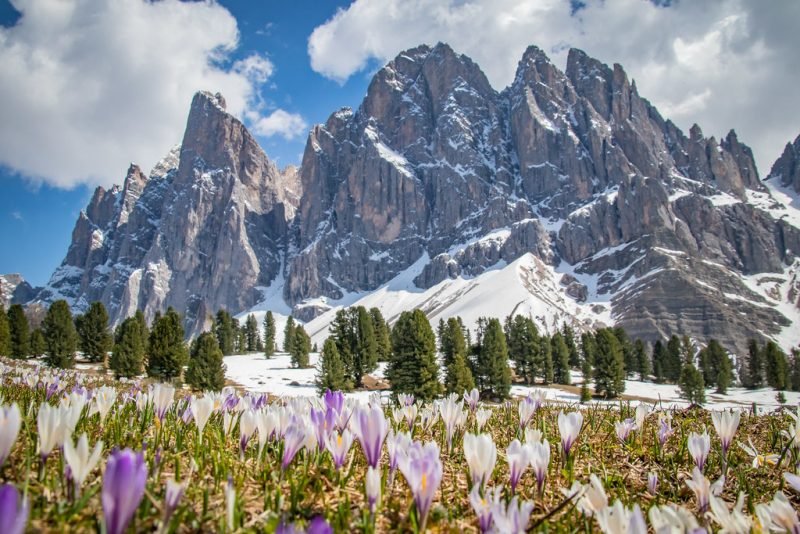
The trail starts from the Malga Zannes parking lot (paid, €10 per day). Keeping the Odle peaks in view, follow trail 36 through the woods until you reach Malga Glatschalm at 1,902 meters. On the day we did the hike, the landscape was surreal, with the mountains still covered in snow!
Near Malga Glatschalm, a detour onto trail 35 continues, again through woods and meadows, up to Rifugio delle Odle and the nearby Malga Casnago Gschnagenhardalm, reaching 2,000 meters. Here the landscape opens up majestically, with the Odle peaks serving as a backdrop to the refuge, so close they seem within reach. The refuge is usually open from December to mid-March and then from mid-May to early November.

On the grassy slope in front of the refuge, a few chairs and benches let you enjoy the panorama in all its glory. We sit facing the sun and eat our sandwiches in front of this view, the “cinema of the Dolomites.” But the horizon isn’t the only thing worth looking at: the meadows are flooded with the white and purple of crocuses, so delicate it feels like a crime to step on them.
From Rifugio delle Odle you can head back to Malga Zannes on trail 34, again through the woods, along a wide, winding road. Overall, this hike has an elevation gain of 410 meters, covered in about 3 hours at an easy pace, with countless photo stops along the way.

Hike to Rifugio Genova
Another of the valley’s most famous hikes also starts from Malga Zannes: the one to Rifugio Genova. In this case, you’ll face a greater elevation gain of 750 meters, reaching an altitude of 2,306 meters.
The trail to follow is number 25 until it meets trail 33, heading toward Malga Gampenalm (2,062 meters). It’s an easy route that climbs gradually, with the iconic jagged profile of the Odle visible on your right.
You cross alpine pastures and fields of crocuses until, up ahead in the distance, you finally spot the Rifugio Genova building itself. In the off-season you’ll meet few hikers, most of whom are tackling the better-known trails.

Before June, this hike can become tricky from Malga Gampenalm onward, as the snow won’t have fully melted yet. We know this all too well, as we had to turn back just short of our destination because we didn’t have microspikes!
From Malga Gampenalm you still get a splendid view of the Odle and the valley below. Side note: this mountain hut, like the others in Val di Funes, stays closed until June. We’ll have to come back another time to stuff ourselves with cheese.

Church of San Giovanni in Ranui
When you think of Val di Funes, you probably picture the Santa Maddalena church, nestled in a meadow beneath the jagged Odle peaks.
Despite its fame, the church of San Giovanni in Ranui cannot be visited, as it’s private property belonging to the Ranui Hof farmstead. By paying a €4 fee, you can access a road leading to a fence, from which you can take a photo of the little church. Spoiler: we didn’t give in to this money-making scheme.

Bressanone
Bressanone was a real surprise for us: bathed in sunshine, it won us over with its colors and typical Tyrolean architecture. Brixen, as it’s known in German, is the historic and cultural capital of the Isarco Valley: a little gem worth visiting for 3 or 4 hours.
What to see in Bressanone? Here are a few things not to miss while strolling through the arcades and cobbled streets of its historic center.
Piazza Duomo. The heart of the city, with its bubbling fountains, flower beds, the Town Hall, and the pastel-yellow towers of the Cathedral rising above it all. The church was rebuilt in Baroque style, with lavishly painted interiors; the adjoining cloister, by contrast, retains a sober Romanesque-Gothic beauty and connects to the other buildings of the complex.

White Tower. One of the city’s symbols, this is the bell tower of the parish church, towering over the historic center at 72 meters tall. Two hundred steps lead to the top, where you can admire the carillon mechanism with its 43 bells, while a museum exhibit inside the tower explains how it works.
Stufles. Bressanone’s oldest district is a maze of pastel-colored houses and small artisan workshops. Its charmingly winding lanes sit at the confluence of the Isarco and Rienza rivers, which flow through the city center.
Bishop’s Palace of Bressanone. This magnificent residence now houses the diocesan museum, with 70 rooms preserving the city’s treasures. We didn’t have time to visit it, but if you love art and can spare a couple of hours, you certainly won’t regret it.

Where to eat in Bressanone: Alter Schlachthof
Overlooking Bressanone’s riverfront, the restaurant Alter Schlachthof is housed in the building that once was the city’s old slaughterhouse and offers a lovely garden during the warmer months.
We tried their excellent craft beers and burgers, but the whole menu looks tempting. For us, this is the place to eat in Bressanone!

Novacella Abbey
A must-see stop for anyone visiting Bressanone is the Novacella Abbey, just a few kilometers from the city center (you can even walk there from Stufles).
It is one of the most important abbeys in northern Italy. The monastery was founded in 1142 by the Bishop of Bressanone, Blessed Hartmann, and for nearly a thousand years has been run by the Augustinian order. These monks, known for their scholarship, have turned the abbey into a true cultural hub, with a vast art collection and a library of about 65,000 volumes.
Among the spaces not to miss is the Renaissance well known as the “well of wonders”, located in the abbey’s main courtyard and decorated with scenes inspired by the seven wonders of the ancient world. The Church of Santa Maria Assunta is a triumph of the Baroque, almost like a jewel box of white and pink stucco, while the cloister leading to it preserves medieval frescoes.


But the most “wow” part of the complex is definitely the library, built in South Tyrolean Rococo style by Antonio Giuseppe Sartori in 1773. Walking in feels like stepping into the library from Beauty and the Beast, except there are far more theology books than novels. A fun fact: the library houses the world’s smallest manuscript.
Outside, we can’t forget the abbey gardens and the Castle of Sant’Angelo, or Chapel of St. Michael (closed at the time of our visit), which is somewhat reminiscent of Castel Sant’Angelo in Rome.

Novacella Abbey is also famous for its wine production, one of the activities that helps the complex remain economically self-sufficient. You can do a wine tasting at the abbey’s wine shop and take guided tours of the surrounding vineyards. From the sacred to the profane, basically!
Novacella Abbey: useful info
- The abbey is open Monday to Saturday, excluding holidays, from 10:00 AM to 5:00 PM (last entry at 4:15 PM).
- The ticket with audio guide costs €13 and the visit takes about 2 hours; you can add €5 to also visit the gardens.
- The guided vineyard tour with wine tasting costs €25 and takes place in the afternoon, Monday to Saturday.
- Discover all tours and buy tickets

Chiusa
Also in the Isarco Valley, Chiusa is another town that makes your heart race. It’s part of the circuit of Italy’s Most Beautiful Villages and enchants with its streets lined with pastel-colored houses.
Its fame is also due to the presence of the Sabiona Monastery, nicknamed the Acropolis of Tyrol for its religious significance and its position atop a hill overlooking the town. You can reach it on foot from the town with a 30-45 minute walk.

For more than three centuries, the monastery housed nuns of the Benedictine order, while today it is run by Cistercian monks. The walled complex is striking for its grandeur and solemnity; it consists of several buildings, such as the Chapel of Santa Maria or delle Grazie, the Church of Our Lady, the Monastery Church, and the Church of the Holy Cross, the latter featuring stunning frescoes.
Sabiona Monastery: useful info
- The outdoor area of the monastery and its churches are freely accessible; the churches are open from 8:00 AM to 5:00 PM. The monastery’s interior rooms, however, cannot be visited.
- To get there, you can follow two trails from the center of Chiusa: the Via Crucis (30 minutes) and the Sabiona walk (45 minutes). The elevation gain is about 500 meters.

Where to eat in Chiusa: Gassl Bräu
After the trek up to Sabiona Monastery, there’s nothing better to recharge than a good Tyrolean lunch. We recommend Gassl Bräu, a brewpub in the center of Chiusa. Besides their own house-brewed beers, you can enjoy hearty, delicious dishes like canederli and Wiener Schnitzel.

Where to stay in Val di Funes
To visit Val di Funes, Bressanone and Chiusa, we recommend Jausenstation Moar, a haven amid meadows and alpine pastures at 1,340 meters above sea level.
The apartments are large (huge, actually), new, clean, and equipped with everything you need, even for long stays. We had a wonderful time, and their food is fantastic, with more than affordable prices. Not to mention the adorable little goats in their mini petting zoo!

Where to eat in Val di Funes
Among the recommended places to eat in Val di Funes, we suggest:
- Viel Nois. In the center of San Pietro, this restaurant is open from breakfast through dinner. It offers local dishes and more, with meticulous attention to plating. We liked it so much that we had dinner here two nights in a row. The property also includes a guesthouse and a spa, which look delightful in the photos.
- Jausenstation Moar. The property where we stayed is also an inn serving traditional cuisine. We tried their canederli and breakfast pastries: amazing!

If you feel a crisp mountain breeze and the scent of freshly baked strudel, you’re probably not hallucinating: it’s Val di Funes calling you! Start polishing your hiking boots and get ready to head there. For any doubts, questions, or curiosities, we’ll be waiting for you in the comments!
Enjoying our articles? Subscribe to our newsletter for travel updates, sneak peeks, and discount codes 🙂